Form N-400 Deep Dive: How to Fill Out, Submit, and Track Your Citizenship Application

Form N-400, Application for Naturalization, is the form that turns a green card into U.S. citizenship. It is long — more than a dozen parts — but most of it is straightforward if you prepare your documents first. This guide walks through the form section by section, flags the details that cause delays or denials, and explains how to submit and track your application.
Before you start
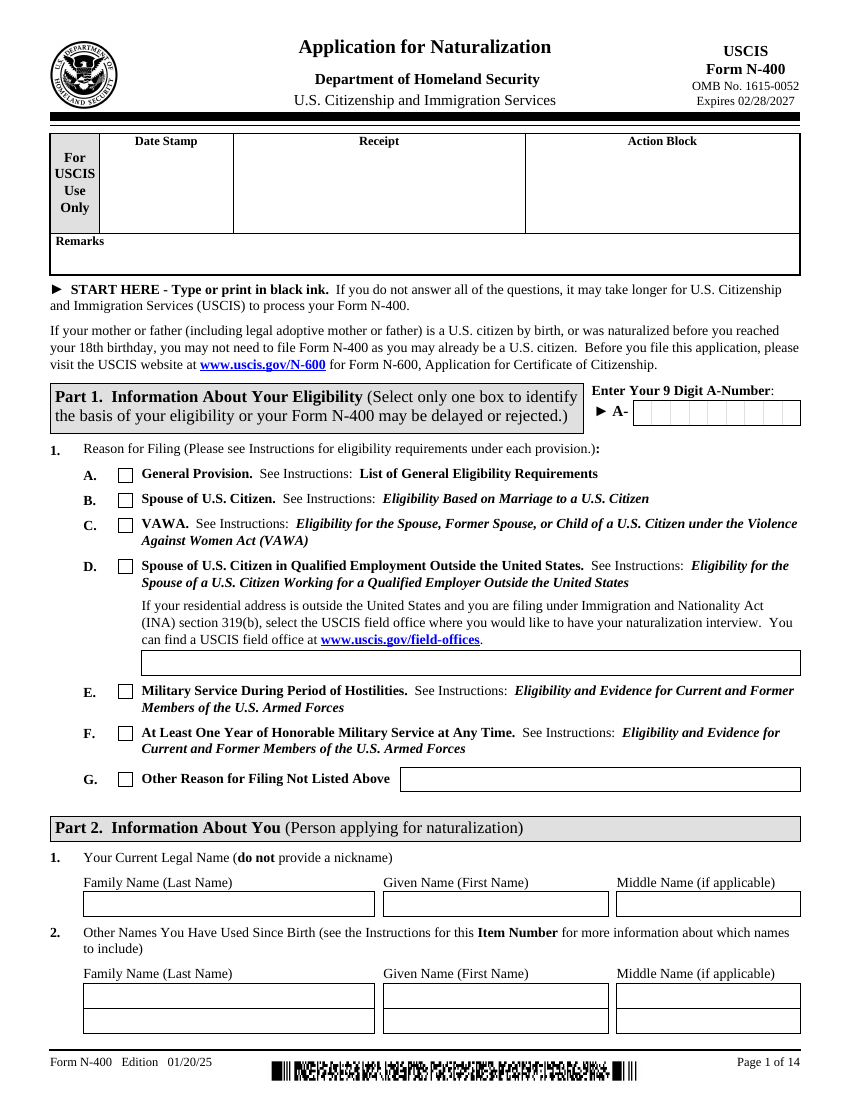
- **Use the current edition.** The edition date is printed at the bottom of every page (the current edition is dated 01/20/25). Download the current Form N-400 from USCIS. If you mail a paper form, every page must be from the same edition, with the edition date and page numbers visible — USCIS may reject mixed or incomplete pages.
- **Gather your documents first:** your green card, all passports since you became a resident, your travel history (every trip outside the U.S. with dates), your address history for the last 5 years, your employment history for the last 5 years, and — if applying through marriage — your marriage certificate and proof of your spouse's citizenship.
- **Check your filing date.** You can file up to 90 days before your 3-year or 5-year anniversary as a permanent resident. Earlier than that, and the application is rejected.
The form, part by part
Part 1 — Information About Your Eligibility
You pick the category you are applying under: 5-year resident, 3-year spouse of a U.S. citizen, military service, or another category. **Pay attention:** choosing the wrong category is a common mistake. If you qualify under more than one (for example, 5 years as a resident and married to a citizen), pick the one with the strongest evidence.
Part 2 — Information About You
Your legal name exactly as it appears on your green card, plus any other names you have used. This is also where you can **request a legal name change** — if you want a new name, enter it here and it can be made official at your oath ceremony (only at ceremonies conducted by a judge).
Part 3 — Biographic Information
Ethnicity, race, height, weight, eye and hair color. These are for identification only and do not affect your eligibility.
Part 4 — Information About Your Residence
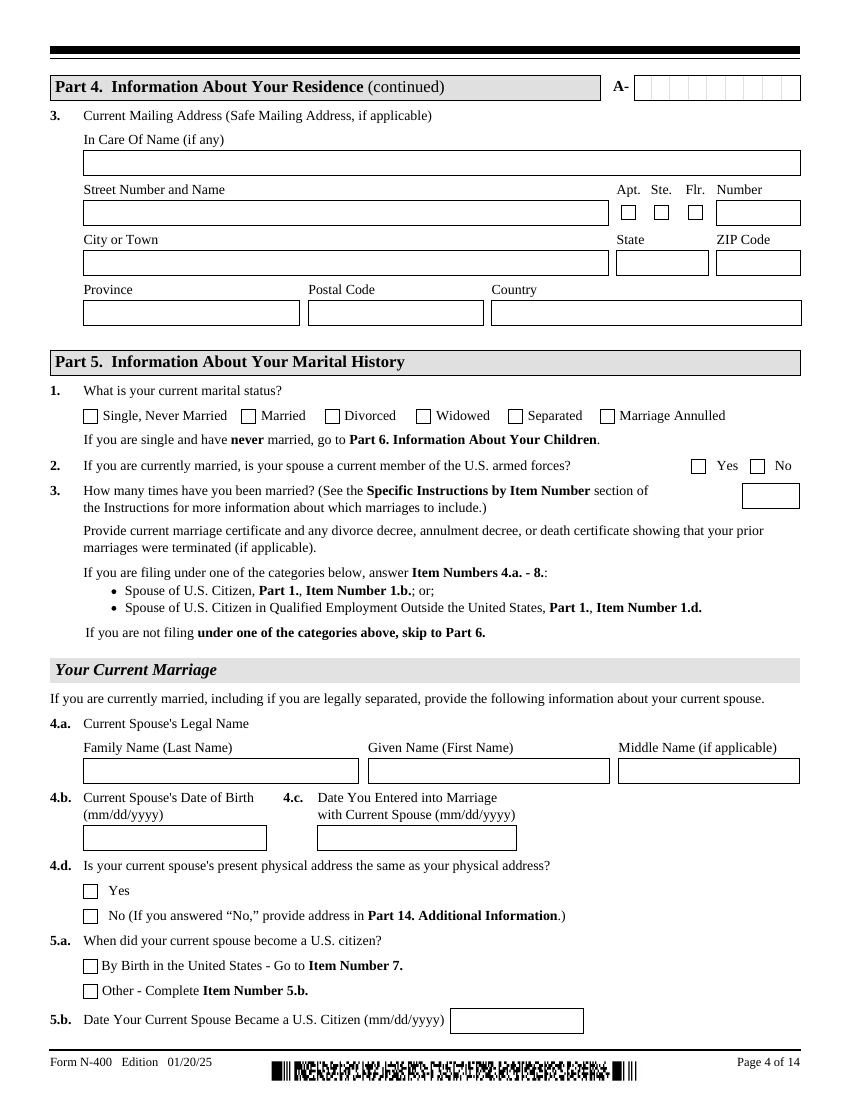
Your current physical address and mailing address. **Pay attention:** you must have lived in your state or USCIS district for at least 3 months before filing. If you move after filing, update your address with USCIS immediately — interview notices go to the address on file.
Parts 5–8 — Residence, Employment, and Travel History
This is where most mistakes happen:
- **Address history (5 years):** list every address with no gaps. If you were between homes for a month, say so — gaps raise questions.
- **Employment and school history (5 years):** same rule — no unexplained gaps. Unemployed periods are fine; just list them honestly.
- **Travel history:** list **every** trip outside the U.S. since you became a resident, with exact departure and return dates. Cross-check against your passport stamps and airline records. Trips over 6 months can break your continuous residence, so accuracy matters — a wrong date can turn a 5-month trip into a 7-month problem.
Part 9 — Information About Your Marital History
Current and previous marriages, for you and your spouse. If applying under the 3-year rule, this part carries extra weight: USCIS will look for proof that your marriage is genuine and that you live together.
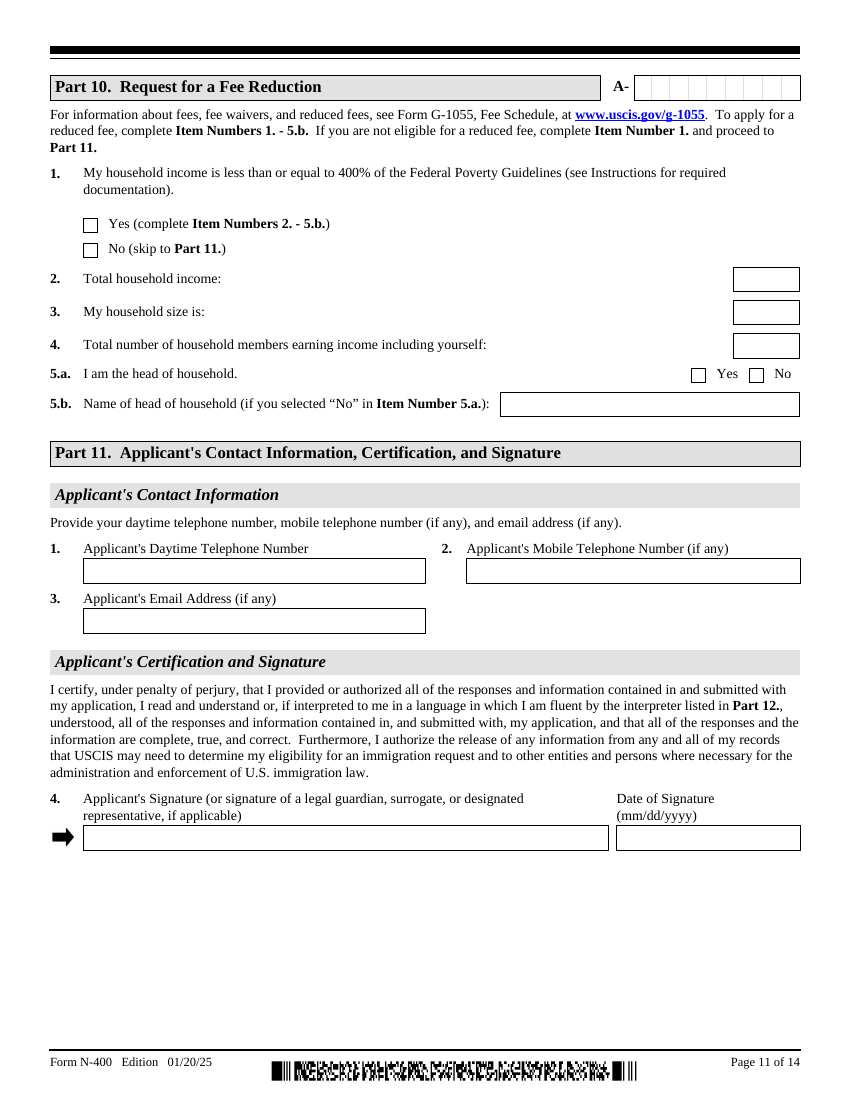
Part 10 — Reduced Fee Request
If your household income is between 150% and 400% of the Federal Poverty Guidelines, you can request a **reduced fee of $380** here. Note: reduced-fee requests must be filed **by mail**, not online.
Part 11 — Additional Information (the yes/no questions)
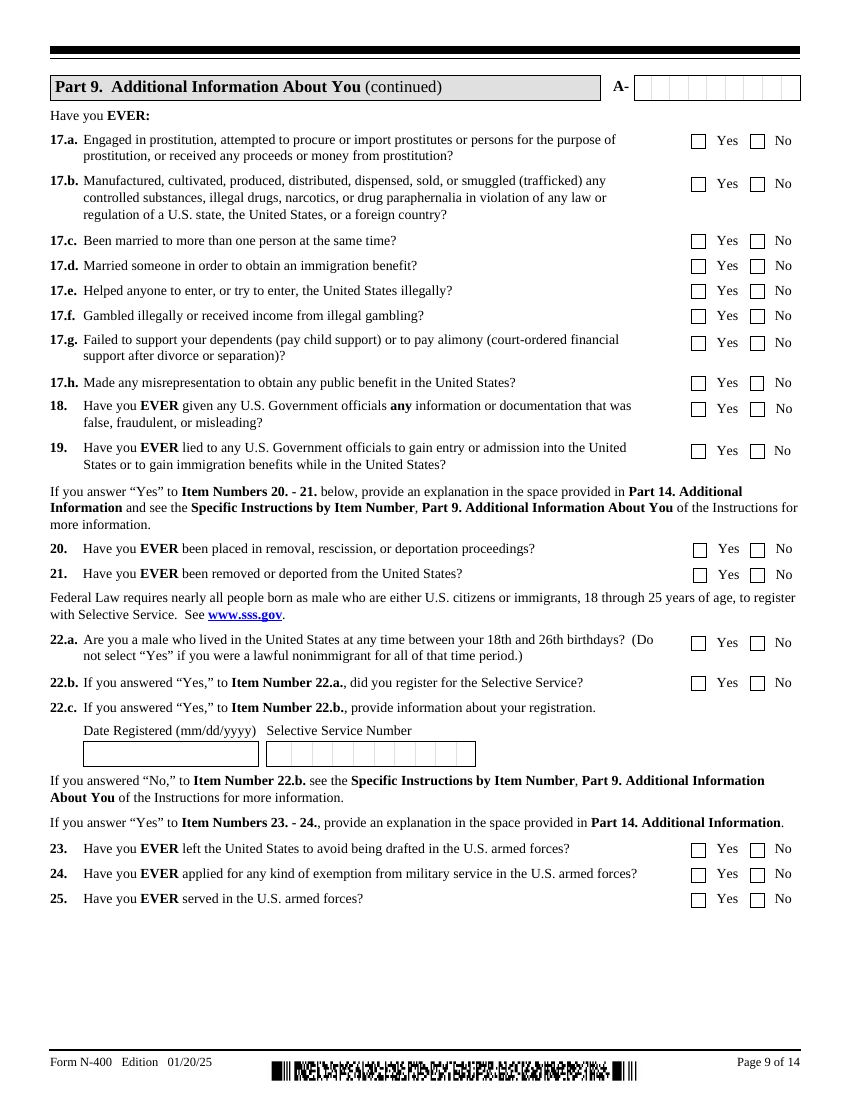
The longest part: dozens of questions about arrests, taxes, child support, memberships, voting, and loyalty to the Constitution. **Pay attention:**
- Answer every question truthfully, even if the answer is uncomfortable. A lie on the N-400 is usually worse than the underlying fact.
- "Have you ever been arrested" means **ever**, even if charges were dropped or records expunged. Disclose it and bring certified court records to your interview.
- Owing taxes is not an automatic denial — but you must show you are on a payment plan or have resolved it.
- Men who lived in the U.S. between ages 18 and 26: you may be asked about Selective Service registration. If you failed to register, get a status information letter before filing.
Part 12 — Oath Requirements
Questions about your willingness to take the Oath of Allegiance, bear arms, or perform noncombatant service. Answering "no" to some of these requires a written explanation and supporting evidence (for example, religious beliefs).
Fees and fee help
- **Standard fee:** $710 if you file online, $760 if you file by mail
- **Reduced fee:** $380 for household income between 150% and 400% of the poverty guidelines (mail only)
- **Fee waiver:** if you receive a means-tested benefit, your income is at or below 150% of the poverty guidelines, or you face extreme financial hardship, you can request a full waiver with Form I-912, Request for a Fee Waiver (mail only — do not send any fee with a waiver request)
- **Military applicants** under INA 328 or 329 pay no fee at all
How to submit
Online (recommended)
1. Create a free USCIS online account at my.uscis.gov 2. Fill out the N-400 in the account — it saves your progress 3. Upload supporting documents and pay the fee online 4. Submit and watch for your receipt notice
By mail
1. Print the current edition of the form — all pages, same edition 2. Fill it out in black ink or type it, then sign it (an unsigned form is rejected) 3. Include the fee (check or money order, or Form G-1450 for a credit card) and copies — not originals — of supporting documents. You can also attach Form G-1145, e-Notification of Application Acceptance, and USCIS will text or email you when it receives your application. 4. Mail to the USCIS lockbox for your state, listed in the form instructions
After you submit: tracking your case
1. **Receipt notice (Form I-797C):** arrives within a few weeks. It has your 13-character receipt number (three letters plus ten digits, like IOE0912345678). 2. **Track your status:** enter that number on the USCIS case status page or in your online account. Online filers see updates automatically. 3. **Check processing times:** the USCIS processing times tool lets you pick Form N-400 and your field office to see the current estimate — most offices take 9 to 18 months. See our office-by-office breakdown. 4. **Biometrics appointment:** most applicants get a notice for fingerprinting a few weeks after filing. 5. **Interview notice:** the big one. It sets your interview date — where you will take the English and civics tests. 6. **Decision and oath:** many applicants get a decision the same day; the oath ceremony follows days to weeks later.
If your case goes beyond the posted processing time, you can submit an "outside normal processing time" inquiry online.
The interview is coming — prepare now
The months between filing and interview are the perfect time to study for the civics test. If you filed on or after October 20, 2025, you will take the 2025 test: 20 questions from 128, needing 12 correct. Start with our free practice tests and flashcards so the test is the easiest part of your interview.
*Sources: USCIS — Form N-400, USCIS — Form N-400 Instructions, USCIS — 10 Steps to Naturalization, USCIS — Form N-400 FAQ*